FACULTY-LED PROGRAMS · FLORENCE
Faculty-led in Florence - the campus model for the most serious U.S. partners.
Florence is our primary hub for faculty-led programs, and the city where the institutional solidity of our model shows best. The Via Bolognese campus is a dedicated 17th-century building, the former study house of the Padri Scolopi (once the Istituto Pellegrini), set within over 8,000 m² of grounds with olive trees and a football pitch, five minutes from the center of Florence. The site brings together, at a single address, 14 classrooms, a 36-station language laboratory, a 150-seat auditorium, a library and study rooms, an in-house café (the Unicafè) and a student residence on the top floor.
For a U.S. university bringing a faculty-led semester to Florence, this is an operational depth that most Italian-language schools do not possess: you can house a group, teach them, host lectures and run student services, all within a single integrated campus. The visiting faculty member retains full academic authority (syllabus, learning outcomes, instruction, assessment, grading), while our Partner Desk handles everything else: the Italian-language component, the cultural program, accommodation logistics, documentation. The result is the continuity of your home curriculum, combined with one of the most coherent campus environments available to U.S. partner institutions in Italy.
Considering other cities? See Faculty-led in Mantua ("Deep Italy" semesters) · Faculty-led overview (all four cities).
How a faculty-led program works with us
Your faculty member leads the academic vision. The visiting faculty member designs the academic content, teaches the disciplinary course, sets the assessment criteria and assigns grades. We are not co-instructors and we do not intervene on the academic side: the credits belong to your institution. We handle everything else. Classrooms and study spaces, campus or affiliated accommodation, ground transport, field-study logistics, Italian-language teaching at the appropriate level (where the project provides for it), on-site student services, cultural program and integration with our resident operations team. Approval-ready documentation. See the Academic Approval Pack, the structured set of documents we issue to support curriculum approval, risk-management review, insurance verification and your institution's study-abroad office sign-off. One Partner Desk, one point of contact. You work with a single Partner Desk contact across the entire program lifecycle: pre-departure planning, on-site management and end-of-program reporting. No stack of vendors to coordinate, no fragmented communication.
Three phases of program support
Our Partner Desk operates across the entire lifecycle of a faculty-led program, from initial scoping to end-of-program reporting. The structure mirrors the standard expectations of U.S. study-abroad offices and accreditation reviewers.
Pre-departure. Academic Approval Pack tailored to your institution, program integration with our facilities, faculty briefing, draft program calendar, risk-management documentation, health and safety brief, accommodation inventory and assignment plan, pre-departure orientation materials for students, visa documentation guidance, advance cultural-immersion planning. On-site management. Arrival welcome, airport-transfer coordination, check-in to campus or affiliated accommodation, on-site welcome and orientation, access to classrooms and laboratories, day-to-day operations support, weekly cultural program, office for the faculty member, 24-hour emergency contact, ongoing health and safety supervision, mid-program review. Re-entry and reporting. Final student debrief, attendance and participation records issued in the format required by your registrar, feedback session with the faculty member, end-of-program report to the home institution, transcript-compatible documentation where needed, partnership-renewal conversation for future groups. Continuing accountability. Each program is reviewed against the academic and operational plan agreed during scoping. Variations are documented and shared with the home institution, together with proposed corrective measures. We treat end-of-program reporting as the seal of the partnership, not as paperwork.
Program types we have run or can run
Summer programs of 2-4 weeks. Intensive faculty-taught programs around a single discipline: Italian civilisation, art history, architecture, design, food studies, contemporary politics, fashion, music. Group accommodation on or near campus; full cultural program included. Study abroad semester with an Italian-language component. A full 12-16 week semester in which your faculty member teaches the core disciplinary course and we deliver Italian-language teaching in parallel at the appropriate CEFR level. Optional integration with our long-stay study-visa documentation framework. Pre-semester language intensive + main program. Students arrive 2-4 weeks before the main faculty-led semester for an Italian intensive, then the disciplinary program begins. It is the most common pattern for "Italian + discipline" groups aiming for B1/B2 competence by mid-semester. Custom short courses (1-2 weeks). Executive-education groups, MBA short courses, professional-development groups, alumni programs. Compact, high-density academic content, scheduled around the home institution's calendar. Full academic year. For institutions wanting a continuous study-abroad presence in Italy: a year-long program with group rotation between the autumn and spring semesters, with optional summer continuity. Hybrid and rotating models. Groups moving between two or more of our four cities within a single program, for example Florence (heritage) + Milan (contemporary Italy), or combining on-site weeks with online pre-departure preparation.
What we coordinate on the ground
Beyond classroom teaching, the Partner Desk coordinates the entire operational perimeter of the program. The list below is what is included as standard; further services are available on request and defined during program design.
Arrival and logistics. Airport-transfer coordination · arrival welcome · check-in to campus or affiliated accommodation · local SIM and connectivity guidance · public-transport orientation · welcome kit. Accommodation. Group accommodation in our campus residences (Florence, Mantua) or in selected partner facilities (Milan, Turin) · faculty accommodation options · meal-plan integration · cleaning and maintenance coordination. Visa and immigration administration. Enrollment certificates valid for the consulate · program and contact-hour documentation for visa applications · post-arrival residence-permit support · liaison with consulates and the Questura where needed. Risk management and safety. Full risk-management documentation · health and safety brief · emergency-response protocol · 24-hour emergency contact · alignment with U.S. State Department travel advisories where needed. Health insurance and medical assistance. Coordination of medical-insurance documentation compliant with the requirements of the Italian consulate and the university · local healthcare orientation · general-practitioner guidance for longer programs. Academic operations. Classroom and laboratory scheduling · IT and audiovisual setup · library and study-room access · printing and reprographics support · attendance recording · grade delivery to the home institution.
Optional academic enrichments
Beyond the core faculty-taught course, programs can be enriched with additional learning experiences aligned to the discipline, designed by your faculty member together with our Partner Desk.
Guest lectures and talks. Local academics, industry professionals, curators from cultural institutions delivering targeted lectures, aligned to the faculty member's syllabus. Joint sessions with Italian partner universities where relevant. Field trips and site visits. Discipline-aligned visits: museums, archaeological sites, company headquarters, design studios, regional excursions (Siena, Pisa, Bologna, Rome, the Langhe, Verona, Cremona). Logistics, transport and admission-ticket coordination at our charge. Internships and service learning. Credit-bearing or non-credit placements at local Italian organisations (cultural institutions, NGOs, design studios, small businesses, schools) defined against the program's academic objectives. Conversation partners and teaching placements. One-to-one or small-group matches with Italian university students for groups with a language component · teaching-assistant placements in local schools where relevant to the academic plan. Experiential and community engagement. Hands-on workshops, studio practice, laboratory work, volunteering with local cultural and social organisations · structured community-engagement activities defined against the discipline. Cultural-immersion calendar. Weekly evening and weekend program: cinema, opera (La Scala, Teatro Comunale), regional cuisine, guided walking tours, food and wine excursions, sport, designed around the group's interests and Italian level.
Disciplines we have hosted, or can host
Our four cities, together with our network of academic and cultural partners, support a broad range of disciplinary areas. Below: the disciplines we have worked with most often, matched to the campus whose city offers the strongest field-study environment. Other disciplines are welcome on request: we have run programs ranging from environmental policy to opera studies.
Humanities and cultural studies. Italian civilisation · art history · architecture · Renaissance studies · museology · classical and medieval studies · religious studies · history of science · heritage conservation. Primary hub: Florence · also Mantua. Languages and linguistics. Italian language (A1 → C2) · sociolinguistics · translation and interpreting · L2 teaching · comparative literature · Italian cinema studies. All four cities; primary hubs: Florence and Milan. Business, management and finance. International business · management · entrepreneurship · finance · marketing · luxury and fashion management · sustainability strategy · Italian economic history. Primary hub: Milan. Design, fashion and communication. Fashion design · industrial and product design · graphic design · advertising · media studies · digital communication · visual culture. Primary hubs: Milan and Turin. Food, agriculture and territory. Italian food studies · Slow Food · wine and sommellerie studies · food anthropology · sustainable agriculture · regional terroirs · culinary history. Primary hub: Turin · also Mantua. Social sciences and contemporary Italy. Political science · contemporary Italian politics · sociology · migration studies · European studies · public policy · gender studies · urban studies. Primary hubs: Milan and Turin. Arts, music and performance. Music history and opera studies · performance studies · theatre · creative writing · contemporary art (the gallery scene, Castello di Rivoli, Fondazione Sandretto). All four cities, according to disciplinary focus. Other / interdisciplinary. Engineering site visits · automotive history · environmental policy · comparison of healthcare systems · gerontology · historic-conservation architecture · service learning and community engagement. Defined program by program.
Sample weekly schedule - a day in Florence
Indicative calendar for a 14-week faculty-led semester in Florence with an Italian-language component, delivered at the Padri Scolopi campus. The visiting faculty member teaches the disciplinary course; our team delivers the Italian-language module and the Florence-specific cultural program.
Monday to Friday morning. 09:30 - 11:00 · Faculty-taught course (visiting faculty member, room 1 - first floor of the Padri Scolopi building)
11:00 - 11:15 · Coffee break at the Unicafè, the in-house café on the ground floor
11:15 - 12:45 · Italian-language lesson (CEFR-level group, room 2) Afternoons (vary by day). Mon and Wed: individual study in the campus library and study rooms · faculty office hours · study sessions in the garden in fair weather
Tue: guest lecture or curatorial visit - Uffizi, Bargello, Palazzo Pitti, Accademia, Opera del Duomo, Museo Galileo (every 2 weeks)
Thu: session in the 36-station language laboratory · matches with Italian university-student conversation partners
Fri: city outing - Brunelleschi's Dome, Santa Maria Novella, Santa Croce, Palazzo Vecchio, Mercato Centrale (scheduled per the syllabus) Evenings (optional). Weekly: aperitivo at a partner bar near Piazza Indipendenza or an engagement session with a Florentine cultural institution
Fortnightly: cultural-program event - opera at the Teatro Comunale (Maggio Musicale Fiorentino season), Italian-language cinema, contemporary-art opening
Monthly: regional Tuscan dinner with the group and the faculty member Weekends. Saturday: optional day trip - Siena, San Gimignano, Arezzo, Pisa, Lucca, Cinque Terre, Volterra, the Chianti region (roughly every other weekend)
Sunday: free for individual travel and rest. Mid-program break trip (3 nights in Rome or on the Amalfi Coast) once a semester.
This is an illustrative Florentine calendar. The final calendar is co-designed with the visiting faculty member during scoping to align with the home institution's credit requirements and the discipline-specific learning outcomes.
Pricing model
Faculty-led programs are quoted on a per-group basis, defined against the institutional requirements agreed during partnership development. We do not publish fixed per-student price lists because group size, duration, discipline, language component, accommodation model, the breadth of field trips and faculty accommodation needs all affect the package. The structure below describes what is included and how the model works; concrete pricing is shared in a detailed worksheet during scoping.
Standard inclusions (all programs). Group accommodation in our campus residences or in selected partner facilities · meal plan where applicable · classrooms and laboratories · Italian-language teaching (where the project provides for it) · workspace and support for the faculty member · airport-transfer coordination · welcome kit · 24-hour emergency contact · ongoing student-services support · Academic Approval Pack and risk-management documentation · end-of-program report. Optional add-ons (defined program by program). Lectures by local academics or curators · field trips beyond the standard threshold of 2 per semester · multi-day break trips (Rome, Amalfi, the Alps) · internship placements · service-learning partnerships · matches with Italian university-student conversation partners · advance faculty familiarisation visit · custom recruitment-support materials. Models we operate. All-inclusive per group - a single invoice covers all standard inclusions plus the agreed add-ons. Per-student rate - fixed fee per enrolled student, useful when group size is uncertain. Academic + à la carte hybrid - academic core with optional services invoiced separately. The choice is negotiated at MOU signing. Payment terms. Payment terms align with the fiscal calendars of U.S. institutions · typical structure: 25% deposit at MOU signing, 50% 60 days before arrival, 25% at program close · invoices issued in EUR with a USD reference rate · bank transfer or institutional payment methods accepted · final reconciliation 30 days after the program.
Past Florentine programs and representative groups
The faculty-led programs we have delivered in Florence with U.S. partner institutions span the disciplines below. Specific institution names and references are shared during partnership development on a confidential basis: contact the Partner Desk for a list of Florentine references aligned to your discipline.
Renaissance studies semester. 14-week semester program for a Mid-Atlantic liberal-arts college, 22 students. Renaissance art history taught by the faculty member + Italian language at A2/B1 level + weekly curatorial visits (Uffizi, Bargello, Palazzo Pitti, Accademia) + regional excursions to Siena, San Gimignano, Arezzo. Housed in the campus residence on Via Bolognese. Architecture and heritage-conservation summer. 4-week summer intensive for a U.S. school of architecture, 18 students. Faculty lectures on Brunelleschi, Alberti, Michelangelo + study sessions in the campus Aula Magna + structured visits to Santa Maria del Fiore, San Lorenzo, the Medici Chapels + a 2-day trip to Pisa. Italian civilisation semester. 15-week semester for a Northeastern university, 26 students. Faculty-taught Italian civilisation course + Italian language A1 → B1 + fortnightly matches with University of Florence student conversation partners + cultural-immersion calendar with opera at the Teatro Comunale. Pre-semester language intensive. 3-week Italian-language intensive program for a group of 20 students from an East Coast university ahead of their main semester. Documented A1 → A2 progression, with conversation-partner sessions and weekly trips to Tuscan towns. Fashion and cultural-studies short course. 2-week summer program for a Midwest liberal-arts college, 14 students. Italian fashion history taught by the faculty member + curated visits to the Museo Ferragamo, Gucci Garden, the Pitti Uomo pavilions + craft workshops in Oltrarno. Music history and opera studies. 4-week summer program for a U.S. conservatory group, 12 master's students. Renaissance and Baroque music taught by the faculty member + visits to the Maggio Musicale Fiorentino archives + masterclasses in the campus auditorium + opera performances in Florence and Pisa.
The programs above are representative and anonymised. References, partnership-scope transcripts and direct contacts at past partner institutions are available under the usual confidentiality terms: request them through the Partner Desk.
What our partners say
Visiting faculty director, Renaissance studies semester, Florence
"The Partner Desk structure made the program simple to manage. The pre-departure documentation was already aligned with what our study-abroad office expected: we did not have to invent a procedure. On-site, the language teaching integrated cleanly with my course, and the 24-hour contact gave me real peace of mind."
Study Abroad director, partner institution, multi-year semester relationship
"What surprised us was the operational depth. We had already run faculty-led programs in Italy with other providers, and what made Accademia di Italiano different was the single-point-of-contact model. One Partner Desk contact from scoping to the end-of-program report, with no fragmented stack of vendors."
Visiting faculty member, Italian civilisation semester, Mantua
"My students made concrete linguistic progress over 14 weeks: measurable, documented and visible in their final presentations in Italian. The conversation-partner program with Italian university students was a quiet but transformative element."
Associate Provost, partner liberal-arts college, semester program
"The Academic Approval Pack made the curriculum-committee review at our institution unusually smooth. The documentation was already framed in the language our reviewers needed: risk management, learning outcomes, credit alignment. We approved the partnership in a single committee cycle."
How to start a partnership - the timeline
The typical path from a first conversation to an arriving group. Concrete dates are negotiated to align with your institution's curriculum-approval and admissions cycles; the steps below are the standard sequence.
1 · Initial enquiry. You contact the Partner Desk with a brief picture: institution, faculty member leading the program, target dates, group size, discipline, language component required, main constraints. We respond within two working days with an invitation to a first call. 2 · Intake call. A 45-60 minute call with the Partner Desk and (where relevant) the academic coordinator on our side. Aim: to understand the academic vision, institutional context and operational requirements. We document the call in a structured intake brief that we return to you within five working days. 3 · Site visit / faculty fam trip. The visiting faculty member and (optionally) a study-abroad office representative come to Italy for a 2-4 day campus visit. We arrange classroom tours, demonstration lessons, meetings with our academic team and a tour of accommodation options and field-trip destinations. 4 · Scoping document. A detailed scoping document is developed together: program structure, calendar, syllabus integration, language-component design, accommodation plan, field-trip calendar, risk-management plan, Academic Approval Pack outline and a draft pricing worksheet. Iterated until both sides are aligned. 5 · MOU signing. Memorandum of Understanding (or equivalent partnership agreement) drafted and signed. It covers academic perimeter, operational responsibilities, pricing and payment terms, risk allocation, intellectual property, data protection and exit clauses. Reviewed by the legal offices of both institutions. 6 · Operational setup and recruitment. Joint launch of student recruitment at the home campus (information sessions, marketing materials, application platform). On our side: delivery of the Academic Approval Pack, confirmation of accommodation bookings, scheduling of the Italian-language placement test, release of the faculty pre-departure pack, finalisation of the risk-management protocols. 7 · Arrival and program delivery. The group arrives. The three support phases activate as described above (pre-departure, on-site, re-entry). A single Partner Desk contact throughout. 8 · End-of-program review and renewal. End-of-program debrief, report to the home institution, satisfaction-survey results, accounting reconciliation. The partnership-renewal conversation usually takes place within 30-60 days of program close, in time for the next academic cycle.
The Padri Scolopi campus - the facilities in brief
17th-century building on Via Bolognese, owned by the Padri Scolopi, set within over 8,000 m² of grounds with olive trees and a football pitch. Inside: 14 classrooms (25 seats on average), IT and language laboratory with 36 stations plus simultaneous-interpretation booths, a 150-seat auditorium, a library and study rooms, an in-house café (the Unicafè) and a student residence on the top floor with fully equipped common areas (kitchen, laundry, facilities). A five-minute walk from the Florence campus of New York University.
Florentine regional context - the field-trip and excursion network
Florence sits at the center of one of the densest cultural and field-study networks in Europe. Programs can integrate excursions to any of the destinations below, as standard inclusions or as add-ons defined case by case.
In Florence (day visits). Uffizi · Bargello · Palazzo Pitti · Accademia · Opera del Duomo · Museo Galileo · Brunelleschi's Dome · Santa Maria Novella · Santa Croce · Palazzo Vecchio · Mercato Centrale · Museo Ferragamo · Gucci Garden · craft workshops in Oltrarno. Tuscany (day-trip radius). Siena · San Gimignano · Arezzo · Pisa · Lucca · Volterra · Cortona · Montepulciano · the Chianti region · the Versilia coast · the Maremma · Cinque Terre (with a longer day). Italy beyond Tuscany (weekend / break-trip radius). Rome, Bologna, Venice, Ravenna, Verona, the Amalfi Coast, Pompeii, Naples, reachable in 2-4 hours by high-speed rail from Firenze Santa Maria Novella station. Standard mid-program break trip: Rome (3 nights). Want a focus on a different Italian city?. For "Deep Italy" small-town immersion, see Faculty-led in Mantua. For all four cities (Milan and Turin included), see the faculty-led overview.
Talk to the Partner Desk about a program in Florence
Send us the program details: the Partner Desk replies within 2 business days with a proposal and a draft Academic Approval Pack.
• Home institution and Program Director
• Academic dates and group size
• Academic framework: course, credits, language component, optional internship
• Study-abroad office or curriculum committee requirements
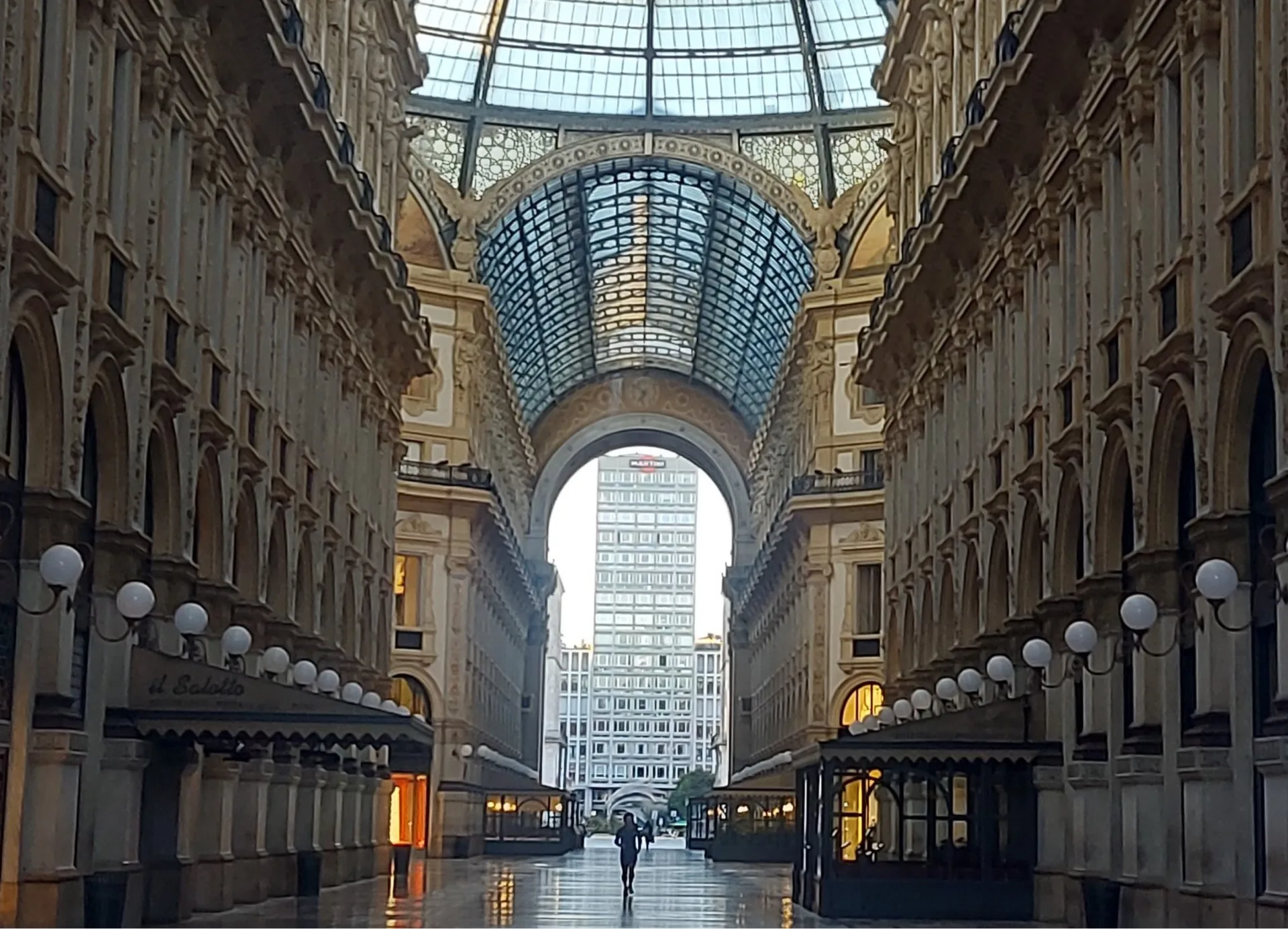
Milan
A short walk from the Duomo, in the heart of the city that never stands still. Here you learn Italian and use it straight away, every day: between work, fashion and aperitivi.
Milan