FACULTY-LED PROGRAMS · HOW IT WORKS
How a faculty-led program works with us: academic model and operational support.
Our faculty-led programs are conceived as an extension of your home campus and of your curriculum: the visiting faculty member retains full academic authority, and our Partner Desk handles all the operational work around the academic core, across three structured phases that mirror the standard expectations of U.S. study-abroad offices.
Institutional base: Accademia di Italiano operates as part of Unicollege SSML, an Institute with University Standing accredited by the Ministry of University and Research (MUR). Our faculty-led programs therefore sit within a recognized Italian higher-education framework, not in a standalone language school: this is also why our documentation tends to clear U.S. curriculum committees in a single review cycle.
How a faculty-led program works with us
Your faculty leads the academic vision. The visiting faculty member designs the academic content, teaches the specific disciplinary course, defines the assessment criteria and assigns student grades. We are not co-instructors and we do not intervene on the academic plane: the credits remain with your institution. We handle everything around it. Classrooms and study spaces, accommodation on campus or in affiliated facilities, ground transport, field-study logistics, Italian language instruction at the appropriate level (where the program calls for it), on-site student services, cultural programming and integration with our resident operational team. Documentation ready for approval. See the Academic Approval Pack: the structured set of documents we issue to support curriculum approval, risk-management review, insurance review and the sign-off of your institution's study-abroad office. One Partner Desk, one point of contact. You work with a single Partner Desk contact for the entire program lifecycle: pre-departure planning, on-site management and post-program reporting. No vendor stack to manage, no fragmented communication.
Three phases of program support
Our Partner Desk operates across the entire lifecycle of a faculty-led program, from initial scoping to post-program reporting. The structure mirrors the standard expectations of U.S. study-abroad offices and accreditation reviewers.
Pre-departure. Academic Approval Pack tailored to your institution, syllabus integration with our facilities, faculty briefing, draft program calendar, risk-management documentation, health and safety brief, accommodation inventory and assignment plan, pre-departure orientation materials for students, visa documentation guidance, early cultural-immersion planning. On-site management. Arrival reception, airport transport coordination, check-in at on-campus or affiliated accommodation, on-site welcome and orientation, access to classrooms and laboratories, daily operational support, weekly cultural programming, office space for the faculty member, 24/7 emergency contact, continuous health and safety monitoring, mid-program review. Re-entry and reporting. Final debrief with students, attendance and participation records issued in the format required by your registrar, feedback session with the faculty member, post-program report to the home institution, transcript-compatible documentation where needed, partnership-renewal conversation looking ahead to future cohorts. Ongoing accountability. Each program is assessed against the original academic and operational plan agreed during scoping. Deviations are documented and shared with the home institution, together with the proposed mitigations. For us, post-program reporting is the seal of the partnership, not a bureaucratic formality.
What we coordinate on the ground
Beyond classroom management, the Partner Desk coordinates the entire operational footprint of the program. The list below is what is included as standard; further services are available on request and are defined during program design.
Arrival and logistics. Airport transfer coordination · arrival reception · check-in at on-campus or affiliated accommodation · local SIM and connectivity guidance · public-transport orientation · welcome kit. Accommodation. Cohort accommodation in our on-campus residences (Florence, Mantua) or in selected partner facilities (Milan, Turin) · accommodation options for faculty · meal-plan integration · cleaning and maintenance coordination. Visa and immigration administration. Enrollment certificates valid for the consulate · syllabus and program-hours documentation for visa applications · residence-permit support after arrival · liaison with consulates and the Questura when needed. Risk management and safety. Full risk-management documentation · health and safety brief · emergency-response protocol · 24/7 emergency contact · alignment with U.S. State Department travel advisories where needed. Health insurance and medical assistance. Coordination of medical insurance documentation compliant with Italian consulate and university requirements · local healthcare orientation · general-practitioner guidance for longer programs. Academic operations. Classroom and laboratory scheduling · IT and AV setup · library and study-room access · printing and reproduction support · attendance recording · grade delivery to the home institution.
Optional academic enrichments
Beyond the core course taught by the faculty member, programs can be enriched with additional learning experiences consistent with the discipline, designed by your faculty member together with our Partner Desk.
Guest lectures and conferences. Local academics, industry professionals and curators from cultural institutions deliver targeted lectures aligned with the faculty member's syllabus. Joint sessions with Italian partner universities where relevant. Field visits and study trips. Visits consistent with the discipline: museums, archaeological sites, corporate sites, design studios, regional excursions (Siena, Pisa, Bologna, Rome, the Langhe, Verona, Cremona). Logistics, transport and entry-ticket coordination handled by us. Internships and service learning. Credit-bearing or co-curricular placements with local Italian organisations: cultural institutions, NGOs, design studios, small businesses, schools, defined according to the program's academic objectives. Conversation partners and teaching placements. One-to-one or small-group pairings with Italian university students for cohorts with a language component · teaching-assistant placements in local schools, where relevant to the academic plan. Hands-on experience and community engagement. Practical workshops, study activities, laboratory work, volunteering with local cultural and social organisations · structured community-engagement activities defined according to the discipline. Cultural-immersion calendar. Weekly evening and weekend programming: cinema, opera (La Scala, Teatro Comunale), regional cuisine, walking visits, food and wine excursions, sport, designed around the cohort's interests and Italian level.
Talk to the Partner Desk about a program
Send us the program details: the Partner Desk replies within 2 business days with a proposal and a draft Academic Approval Pack.
• Home institution and Program Director
• Academic dates and group size
• Academic framework: course, credits, language component, optional internship
• Study-abroad office or curriculum committee requirements
Milan
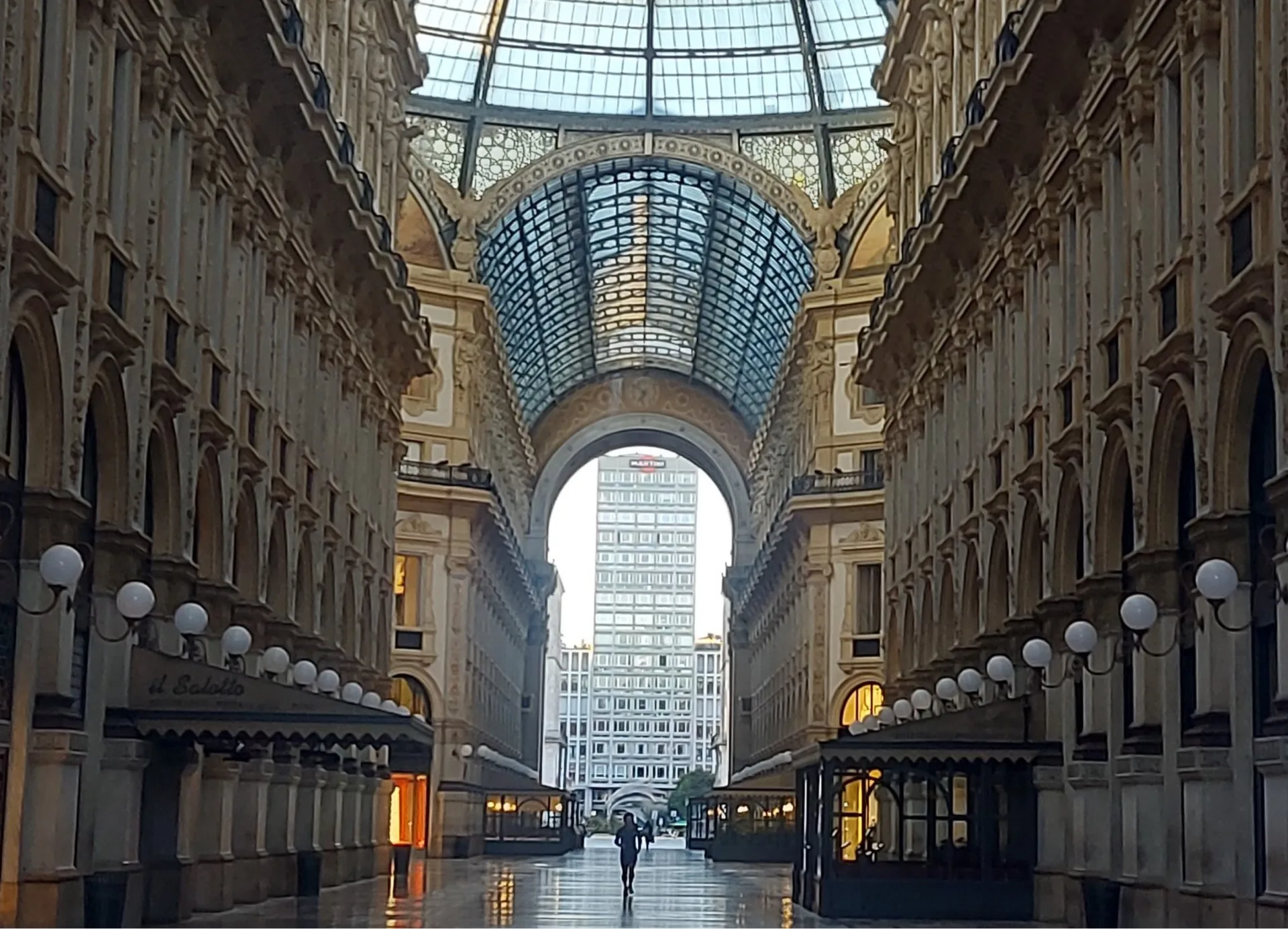
A short walk from the Duomo, in the heart of the city that never stands still. Here you learn Italian and use it straight away, every day: between work, fashion and aperitivi.
Milan